EMI × Kohler · Marketplace Intelligence
Kohler SEA Regional
Home & Living Marketplace Review
Indonesia · Singapore · Thailand — 12-month rolling to June 2026
An executive synthesis of Kohler's regional commercial position across Shopee, Lazada and Tokopedia — category structure, competitive standing, where the region wins and loses, channel quality, pricing and the action plan. Every figure is drawn from EMI's regional deck and is click-to-source. Figures are MAT / 12-month-rolling unless marked, and all values are stated in US dollars — the common currency EMI uses to make Indonesia, Singapore and Thailand comparable in one view.
Executive Summary · Regional Market · Competitive Set · Win / Lose by Market · Growth vs Market · Channel Quality · Pricing · Hero Products · Action Plan · Sources
01 · Executive Summary
The six things to know
- Kohler is the region's #4 premium bathroom brand at 14.5% of the tracked focused-brand set, behind Toto (19.8%), Paloma (17.2%) and Cotto (15.0%) — a close, crowded top tier. source
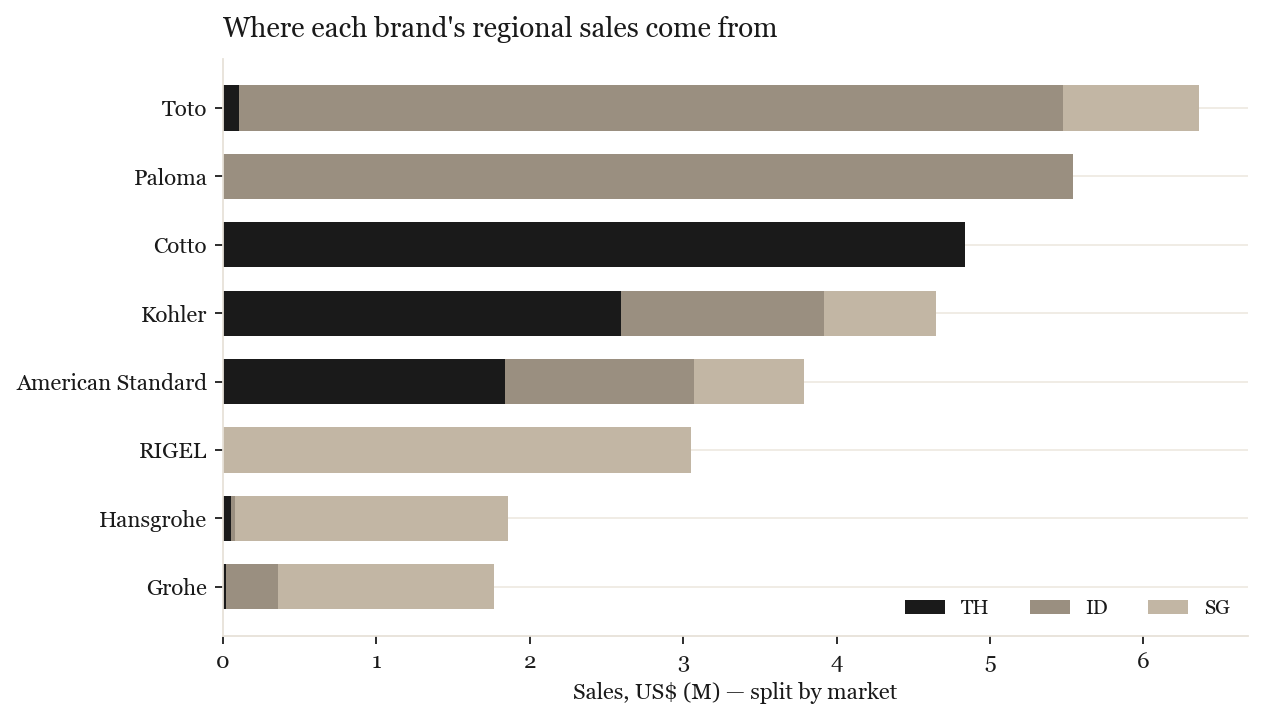
- The position is highly uneven by market: Kohler is #2 in Thailand (27.4%), #3 in Indonesia (9.6%) and only #5 in Singapore (8.3%). It is the most balanced regional player but is #1 in no single market. source
- Kohler is growing fast — +47% MAT year-on-year — but Hansgrohe (+82%), RIGEL (+59%) and Cotto (+57%) are growing faster, so the top-tier order is still in play. source
- That growth rides almost entirely on Shopee (+97% MAT), while Tokopedia is modest (+14%) and Lazada is shrinking (−6%) — a concentration risk. source
- Channel quality is Kohler's structural edge: ~85% of its sales run through official stores versus ~23% for the category, and in official-only stores Kohler ranks #2. source official rank
- The regional category is Shopee-dominated (87.5%) and grey-market-heavy (63%) — a value-driven marketplace where premium sanitaryware is a thin, niche slice against cheap accessories. source deck
02 · The Regional Market
A Shopee-led, grey-market category
The SEA Home & Living category EMI tracks across the three markets is large but unbranded at its core — and overwhelmingly transacted on one platform.
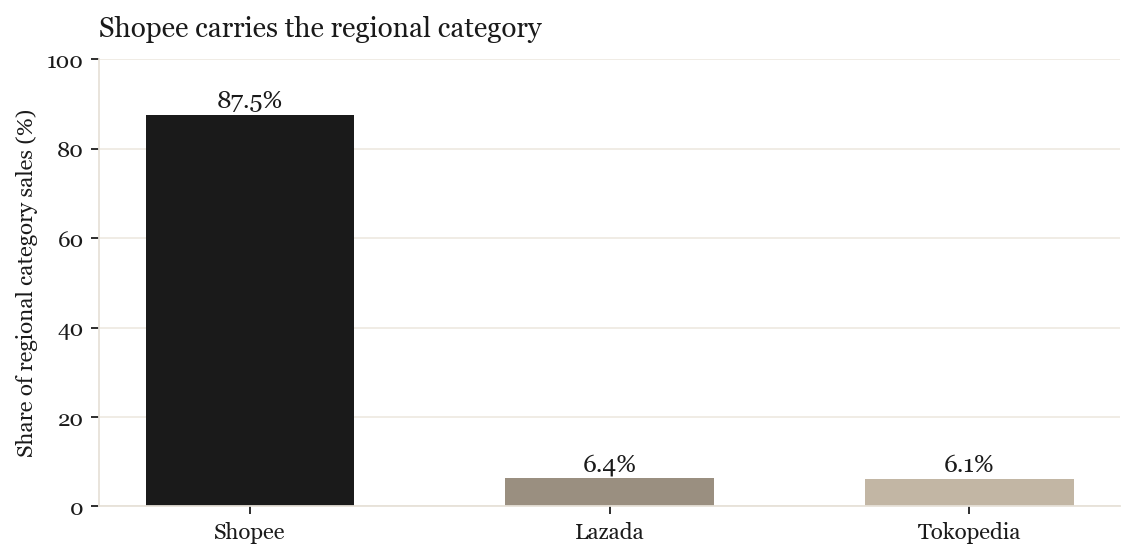
Platform mix differs by market: Indonesia runs on Shopee + Tokopedia; Singapore and Thailand on Shopee + Lazada. Shopee is the common spine across all three. source deck: overview
The category is dominated by unbranded, grey-channel volume
Of the US$231.11M in tracked category sales, 63% flows through grey sellers and only 23% through official stores (14% resellers). The ten tracked premium brands together account for just US$32.14M — about one-seventh of the category; the rest is unbranded and value-tier. The headline contest for Kohler is therefore not "share of category" but share of a small, premium, branded pocket sitting on top of a vast value market. source deck: focused brands
03 · The Focused-Brand Competitive Set
A crowded premium top tier
Within the tracked premium set (US$32.14M, 12-month rolling), Kohler sits fourth — just over five share points of the #1 position, but with two single-market leaders ahead of it.
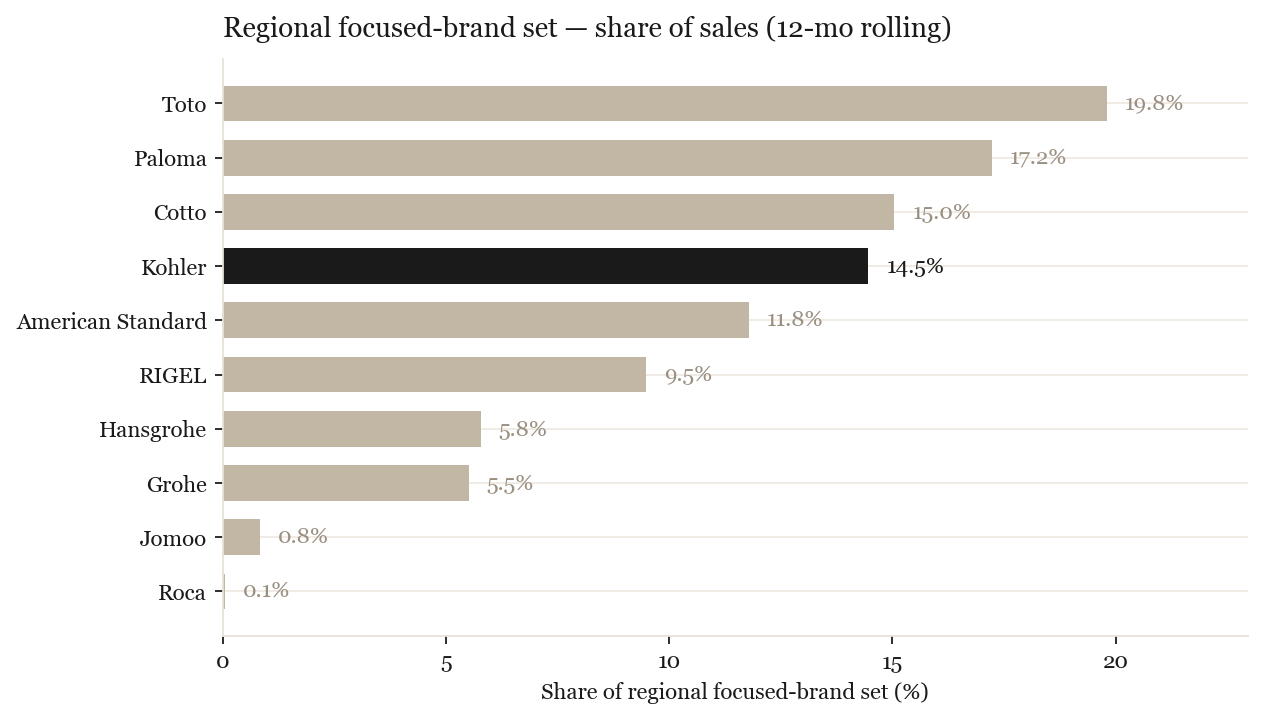
| # | Brand | Regional sales (US$) | Share | Footprint |
|---|---|---|---|---|
| 1 | Toto | 6.36M | 19.8% | Regional (ID-led) |
| 2 | Paloma | 5.54M | 17.2% | Indonesia only |
| 3 | Cotto | 4.84M | 15.0% | Thailand only |
| 4 | Kohler | 4.65M | 14.5% | Regional (all 3) |
| 5 | American Standard | 3.79M | 11.8% | Regional (all 3) |
| 6 | RIGEL | 3.05M | 9.5% | Singapore only |
| 7 | Hansgrohe | 1.86M | 5.8% | Singapore-led |
| 8 | Grohe | 1.77M | 5.5% | Regional (SG-led) |
| 9 | Jomoo | 0.27M | 0.8% | Singapore-led |
| 10 | Roca | 0.02M | 0.1% | ID + TH |
The crucial structural read: two of the three brands ahead of Kohler win by dominating a single home market — Paloma is essentially all-Indonesia, Cotto all-Thailand. Kohler, American Standard and Toto are the only genuinely tri-market brands. Kohler's regional rank understates a real strength — it competes everywhere — but also flags the gap: it leads nowhere. source deck
04 · Where Kohler Wins and Loses
One stronghold, one mid-pack, one weak spot
Read as a portfolio, Kohler's regional 14.5% is the blend of three very different stories.
Thailand — the stronghold
Kohler is the clear #2 at 27.4%, behind only Cotto's ceramic juggernaut (51%) and ahead of American Standard (19.4%). At US$2.60M, Thailand is comfortably Kohler's largest regional market and its profit engine. source
Indonesia — mid-pack behind two giants
Kohler is #3 at 9.6%, but a distant third: Paloma (40%) and Toto (39%) together own ~80% of the premium set. Indonesia is also where Kohler's channel is leakiest — external research flags persistent structural counterfeiting and unauthorised selling on Indonesian marketplaces (see Channel Quality). source EXT ↗ counterfeiting
Singapore — the weak spot
Kohler is only #5 at 8.3%, in a premium-skewed market led by RIGEL (35%), Hansgrohe (20%) and Grohe (16%), with Toto (10%) also ahead. Singapore is the clearest underperformance relative to Kohler's global brand strength. source External research suggests the online #5 is a downstream symptom: premium demand in Singapore is set in the offline interior-designer / trade channel, where Hansgrohe is entrenched — Kohler under-indexes where the specification decision is actually made. EXT ↗ designer channel EXT ↗
05 · Growth vs the Market
Fast — but several rivals are faster
On a moving-annual basis Kohler is growing strongly, but the brands closing on its position are growing faster, and its growth is dangerously concentrated on one platform.
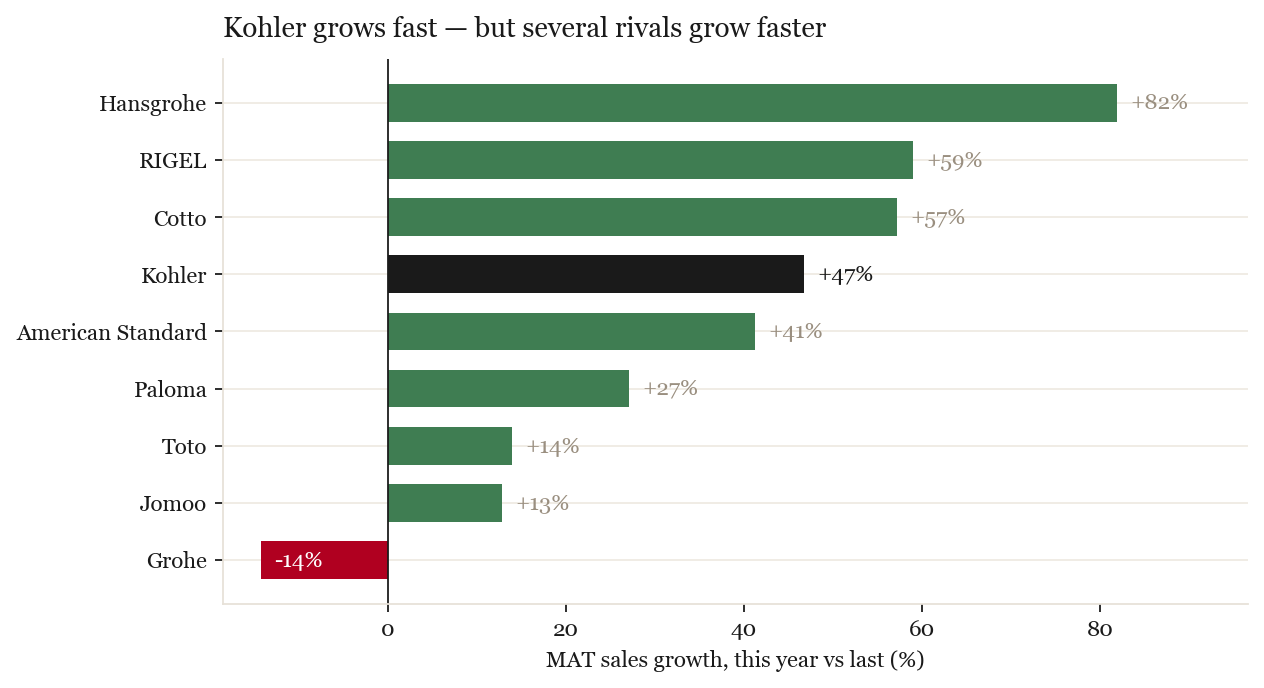
Kohler grew +47% MAT year-on-year — top-tier momentum — but Hansgrohe (+82%), RIGEL (+59%) and Cotto (+57%) all grew faster, while Grohe (−14%) is the only top brand shrinking. The premium pecking order is therefore not settled. source deck
Read with care: the category's reported +114% MAT is lifted by a +158% step-change in Shopee's tracked sales — partly a coverage effect — so the brand-level growth rates above are the cleaner signal. Likewise, single-month June momentum (Kohler −52% MoM in the deck) is volatile and is not used for ranking here. deck: June momentum
Growth concentration: the Shopee dependency
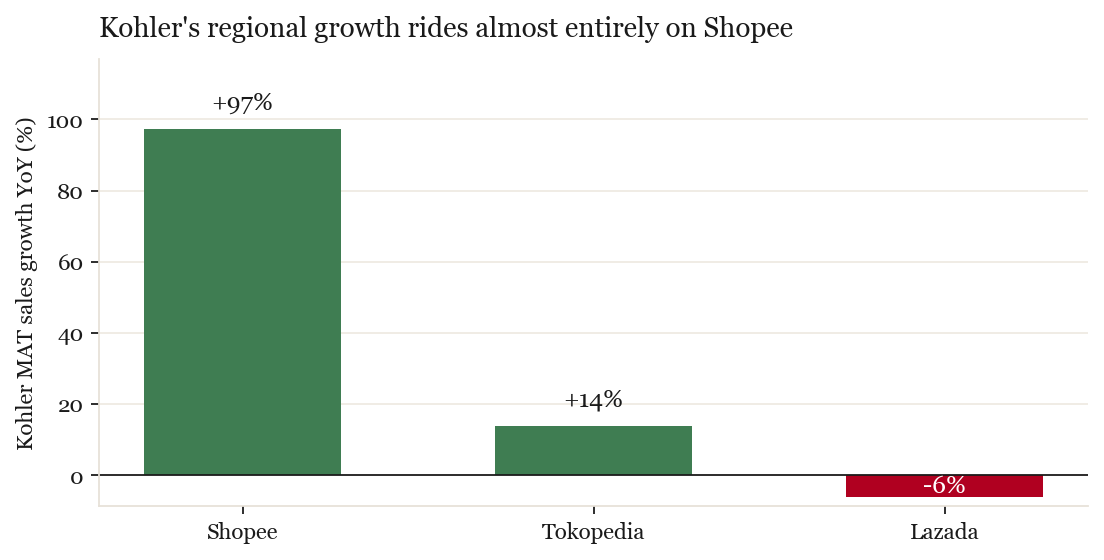
Kohler's regional growth is almost entirely a Shopee story (+97% MAT). Tokopedia adds a modest +14% and Lazada is contracting (−6%). A single-platform growth engine is fragile — a Shopee algorithm shift or fee change would hit Kohler disproportionately. source
External signal · the platform map is shifting under this
Regional e-commerce GMV hit US$157.6bn in 2025 (Shopee ~53%), but the growth has moved: TikTok Shop GMV grew +66% to ~31% of platform GMV, while Lazada fell −28%. At the same time Shopee added a 5% technical-support fee, pushing premium take-rate past 15%. The economics now favour high-AOV products sold through live commerce (5–7% conversion vs ~1–2% for static listings; trusted niche influencers convert up to 82%). The read for Kohler: don't just defend Shopee — deliberately build TikTok Shop as a discovery engine and LazMall as the authenticity boutique. EXT ↗ SEA GMV EXT ↗ TikTok +66% EXT ↗ Shopee fees EXT ↗ live commerce06 · Channel Quality
Kohler sells clean where the category runs grey
Kohler's strongest and most defensible regional asset is the quality of its channel mix.
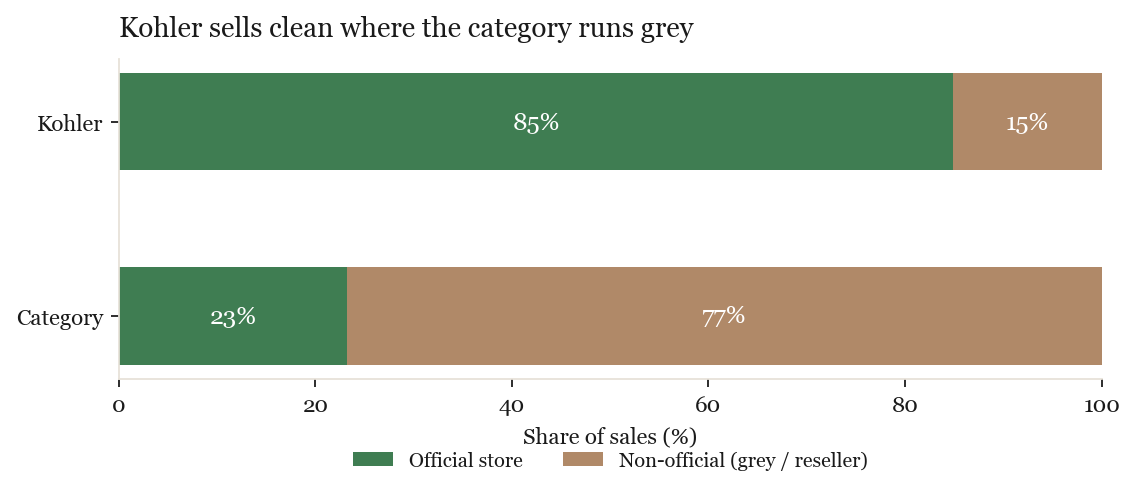
~85% of Kohler's regional sales run through official stores, against just ~23% for the category as a whole (which is 63% grey, 14% reseller) — and against Toto (41%), Grohe (45%) and American Standard (20%), the premium majors Kohler actually competes with. It is a genuine moat: official-store sales protect price, warranty and brand experience in a marketplace built on grey supply. source deck
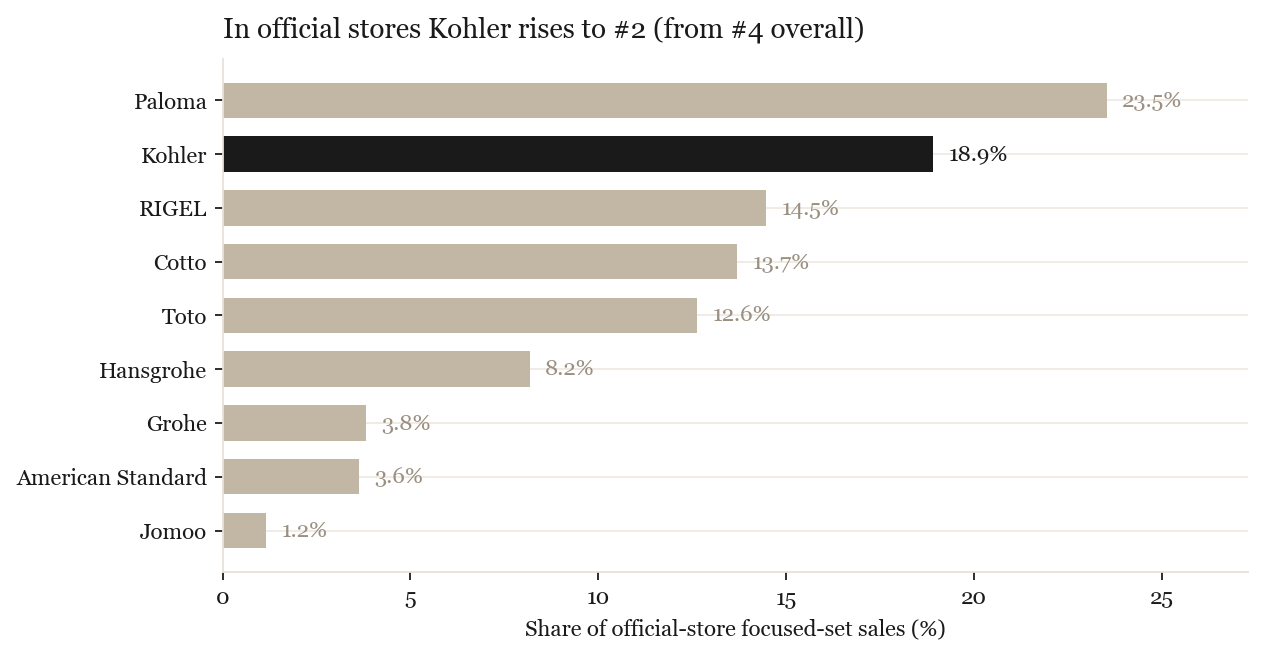
The moat shows up in the rankings: filter to official stores only and Kohler climbs to #2 (18.9%) from #4 overall — ahead of RIGEL, Cotto and Toto, behind only Paloma. Kohler is structurally stronger exactly where buyers trust the channel. source deck
External signal · how to harden the moat
Two mechanisms are worth pursuing. First, blunt the grey market's utility: gate digital warranty activation, software updates and certified installation behind a verified Official-store invoice — a service layer resellers cannot replicate. Second, widen the top of the funnel with a consumable wedge: putting Kohler's proprietary shower filter on a recurring-cartridge subscription (a market growing ~8.4% CAGR) recruits younger buyers, guarantees recurring revenue, and pulls customer data off the anonymous marketplace into Kohler's CRM. EXT ↗ filter market EXT ↗ subscription model07 · Pricing & Segmentation
Anchored low-to-mid, with a premium shoulder
Kohler's regional sales concentrate in the accessible bands, with a distinct secondary peak in the upper-mid tier — the premium shoulder where the brand earns its margin.
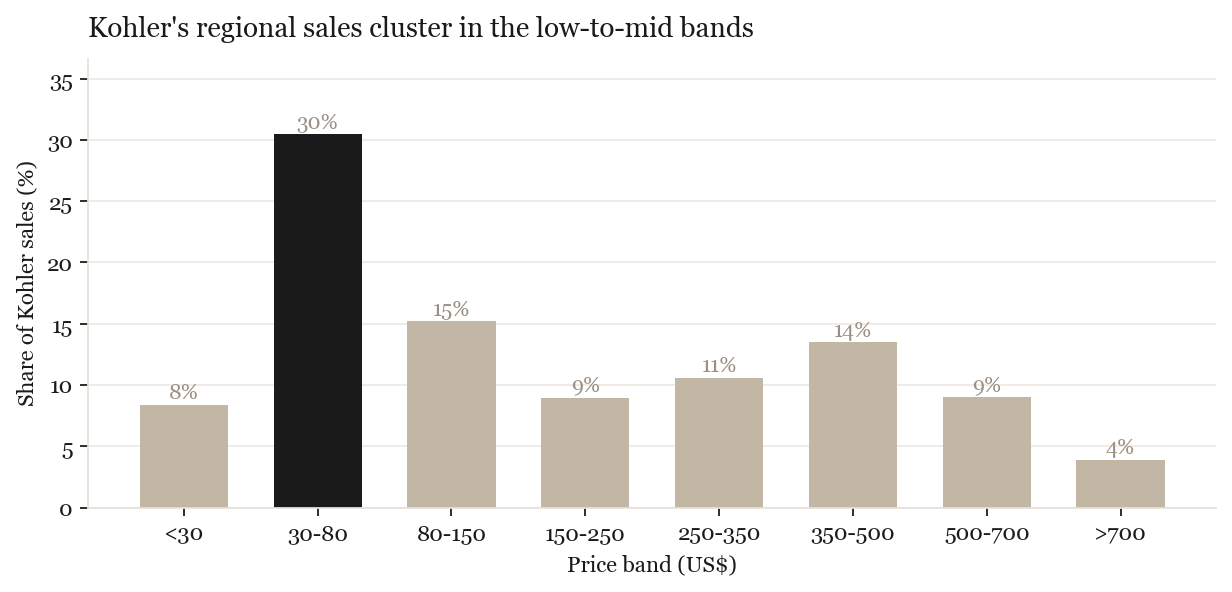
Almost a third of Kohler's regional sales (30%) sit in the 30–80 band, with a further 15% at 80–150 — accessible price points that drive unit volume (handshowers, sprays, accessories). But a clear secondary peak at 350–500 (14%) plus 9% at 500–700 shows Kohler also converts genuine premium demand. Its average selling price (~US$126) is roughly 9× the category average (~US$14) — Kohler competes on value per unit, not volume. source deck: price range
08 · Hero Products
Premium is niche against mass-market fitting volume
The pan-regional best-seller list is a useful reality check on where marketplace volume actually sits — and it is not in premium sanitaryware.
The top-20 best-selling SKUs across all three markets (official stores only) is the raw, unfiltered Home & Living category — dominated by mass-market fittings: full hot/cold shower sets, stainless-steel kitchen sinks, rain-shower columns and jet-shower bidet sprays. Sales run from US$69,061 down to US$16,729, but the average selling prices tell the real story — most sit between US$40 and US$110, with the cheapest at US$8. Premium bathroom brands barely register at the unit-volume top of the market. deck: top 20
Kohler does not appear at all
Kohler holds none of the twenty places. Nor do American Standard, Cotto, Paloma, Grohe or Jomoo — Paloma is present only as a seller (Paloma Hardware, listing the BREZIO brand), not as a brand in its own right. The only tracked premium-set brands to place are RIGEL (two Singapore listings, a rain shower set and a rimless one-piece toilet), Toto (one Singapore one-piece toilet bowl) and Hansgrohe (one Singapore shower system) — and all four of those are the highest-priced rows on the sheet. The rest of the chart belongs to names like ONDA, KOYOT, GUANJIE and HOME LEAF. source
The composition matters as much as the absence: sixteen of the twenty listings are Indonesian and four are Singaporean — there is no Thai entry at all. That is notable, because Thailand is Kohler's strongest market. The regional volume chart is set by Indonesian mass-market fittings, not by where premium brands are strong, so reading it as a scoreboard would systematically mis-price Kohler's position. Kohler's showering range does place in single-market best-seller lists; it simply does not surface in the pan-regional cut. source
This is consistent with the pricing read: Kohler wins on value per unit — a ~US$126 ASP against a volume chart of fittings priced mostly under US$110 — not on appearing in that chart. The strategic takeaway is unchanged and, if anything, sharper: a best-seller-chasing play is the wrong game for a premium brand here. The win is premium showering and smart fixtures, sold clean through official stores. source
09 · AI Action Plan
Eleven regional priorities
Turning the regional read into moves — first-party priorities sharpened with an external-context layer (Aissistance Deep Research), and several new plays the research surfaced, from an after-sales moat to a prefab-bathroom B2B channel and the region's ageing-population shift.
1 · Defend Thailand
Protect the #2 / 27% franchise via showers, thermostatics & smart fixtures — not a ceramic-volume war with Cotto.5 · Fortify the Official moat
Gate warranty, updates & certified install behind Official-store invoices — a service layer resellers can't copy.9 · Build an after-sales moat
Local repair networks & stocked legacy parts — make serviceability a reason to buy Kohler.2 · Win Singapore's trade channel
Attack the interior-designer / specification ecosystem where Hansgrohe is entrenched — not just the listing.3 · Reclaim Indonesia's grey leakage
Warranty-registration walls that strip the post-purchase value from unauthorised stock.4 · De-risk beyond Shopee
Stand up TikTok Shop (+66% GMV) as discovery; LazMall as the authenticity boutique.10 · Open the prefab (PBU) channel
Lock exclusive supply contracts with prefab-bathroom integrators — fixtures specified before ground breaks.7 · Sell a wellness ecosystem
Reframe Anthem/Statement as hydrotherapy systems — countering TOTO WASHLET & GROHE SPA on experience, not spec.8 · Weaponise smart retrofits
Easy-install bidet seats & shower panels sold direct via live commerce — capture upgrades without contractors.6 · Scale the consumable wedge
Put the proven Exhale filter & refill on a subscription and roll it region-wide — younger buyers, recurring revenue, owned CRM.11 · Design for the Silver Economy
Universal-design premium fixtures for a fast-ageing region (Thailand 28% elderly by 2033).- Defend Thailand as the profit engine. Kohler's #2 / 27% Thai position is its single biggest regional asset. With Thai growth slowing and new residential supply soft, do not chase Cotto's ceramic volume; instead own the high-margin smart-retrofit space — upgrades that do not depend on the new-build pipeline. source
- Fix Singapore by winning the trade channel. The online #5 is downstream of the offline interior-designer ecosystem, where Hansgrohe is entrenched. The sharp wedge is a dedicated B2B2C trade programme for top design firms — marketing concealed, space-saving fixtures (HDB constraints) and hero digital showers — not a broad consumer push. source EXT ↗ designer channel
- Grow Indonesia by recovering grey leakage. Kohler is #3 behind two giants owning ~80%, in its leakiest channel. Rather than conquest Paloma/Toto head-on, deploy strict digital warranty registration walls requiring an Official-store invoice, so that grey stock carries no post-purchase support. source
- De-risk the platform mix. +97% Shopee against −6% Lazada makes the engine single-threaded. The regional growth has moved to TikTok Shop (+66%); launch it now as a top-of-funnel discovery channel using design micro-influencers (live commerce converts at 5–7%), while keeping LazMall as the authenticity boutique. source EXT ↗ TikTok EXT ↗ live commerce
- Fortify the official-store moat. 85% official versus a 63%-grey category is Kohler's structural edge. Bundle exclusive online-only SKUs with certified installation and maintenance available only through Official stores — a service barrier no reseller can match. source
- Scale the consumable wedge Kohler already has. This is not a net-new product: the Exhale shower filter (K-30769X) and its refill SKU are already live sellers in Thailand's official stores. Beyond Kohler's accessible-band demand (30% of sales at 30–80), put that proven filter-and-refill pair on a recurring subscription and roll it across all three markets — a category growing ~8.4% CAGR — to recruit younger buyers, bank predictable revenue and pull data into Kohler's CRM. source EXT ↗ filter market EXT ↗ subscription
- Pivot to a "wellness ecosystem" narrative. To bypass the volume fortresses of single-market incumbents, stop selling fixtures and sell systems — position Anthem and Statement as tech-enabled hydrotherapy/wellness experiences, matching TOTO's WASHLET and GROHE's "SPA" plays and shifting the contest to experiential luxury that justifies premium price. EXT ↗ wellness systems EXT ↗ GROHE SPA
- Weaponise smart retrofits across the region. Capitalise on upgrades that bypass full renovation: market easy-install smart bidet seats and premium shower panels direct to homeowners via e-commerce and live commerce. Kohler's Numi wins on wow-factor (TOTO leads on reliability) — so lead with design and experience in the retrofit segment. EXT ↗ flagship head-to-head
- Build a spare-parts and after-sales moat. Smart and electronic fixtures are judged long after the sale, on whether they can be serviced. Decouple servicing from third-party distributors, stand up responsive local repair networks and keep legacy components stocked and affordably priced, so lifetime cost of ownership protects loyalty rather than eroding it. Treat parts availability and repair turnaround as a competitive metric, not a support cost — and audit them against the Japanese majors' local manufacturing footprint before assuming parity.
- Open the prefabricated-bathroom (PBU) B2B channel. Prefab bathroom pods are now specified in ~63% of new hotels over 150 rooms (and over half of senior-living projects); fixtures are chosen at the factory-integrator stage, long before a developer is pitched. Secure exclusive, standardised supply contracts with PBU integrators so Kohler is designed-in to assembly-line bathrooms across the region's hospitality and institutional pipeline — a channel entirely separate from the marketplace. EXT ↗ prefab bathroom units
- Productise for the Silver Economy. The region is ageing fast — Thailand reaches ~28% elderly by 2033 — and premium universal design (discreet ergonomic heights, antimicrobial glazing, slip-resistance built into flagship aesthetics, not clinical add-ons) is becoming table stakes for high-end renovations. Build an accessibility-grade tier that reads as luxury, ahead of the demographic curve. EXT ↗ ageing society
External signal · on the 5-year horizon
One further shift to watch (and pilot early): the med-tech convergence — smart toilets becoming passive health-diagnostic hubs, opening a hyper-premium tier (HK$18k–45k+) that needs a wellness/clinical go-to-market, not hardware retail. EXT ↗ diagnostic toilets10 · Sources
Every insight, traced
Click any insight's “source” tag above, or any thumbnail below, to view the underlying chart or deck slide. Derived charts are computed from the figures in the EMI × Kohler SEA Regional deck (12-month rolling / MAT to June 2026, across Shopee, Lazada and Tokopedia); deck pages are reproduced as click-to-source evidence. Insights marked EXT ↗ draw on a separate external-research layer, cited below and kept distinct from the first-party EMI data.
External research
Aissistance Deep Research, 3-pass run (June 2026). Each item below links out to the cited public source in a new tab; findings are folded into the Action Plan and outlook as a clearly-labelled context layer, separate from the first-party marketplace data.